- Proper paving influences safety, drainage, visitor experience, and operational efficiency across commercial and industrial properties.
- High-quality materials, strong base preparation, and ongoing maintenance extend pavement lifespan significantly.
- WB Paving supports businesses with durable, professional solutions tailored to long-term performance.
A commercial or industrial property carries expectations long before anyone steps inside. The pavement surrounding the building influences how visitors feel, how employees move, how equipment functions, and even how owners protect long-term value. Proper paving supports far more than vehicle access. It strengthens safety, efficiency, appearance, compliance, drainage performance, and overall operational reliability.
Many businesses underestimate how often pavement quietly affects daily function. When paving is done with precision and the right materials, it becomes an asset that supports productivity across the entire property. When it is neglected or installed without attention to engineering, it can lead to hazards, expensive repairs, and a negative impression that undermines the organization’s reputation. This blog explores the deeper importance of proper paving and the role it plays in successful commercial and industrial environments.
How First Impressions Shape Visitor Trust
Visitors form opinions quickly. The pavement they drive or walk on is one of the earliest indicators of how professionally a property is managed. Smooth, uniform surfaces without cracks or standing water show attention to detail. Clean edges, orderly markings, and visible access points suggest the business takes pride in its environment.
Rough surfaces, potholes, faded striping, or pooling water create immediate concerns. They trigger questions about safety and maintenance. Even if the interior of the facility is exceptional, the outdoor environment influences the visitor’s mindset long before they experience the service or operations.
Proper paving directly supports brand perception. Retail centers rely on it to help guests navigate parking areas comfortably. Industrial facilities depend on it to reassure partners that operations are stable and well-maintained. Healthcare buildings, educational campuses, and hospitality sites rely on quality paving to signal security and care. In every setting, impression and trust begin in the parking lot.
The Safety Impact That Businesses Cannot Overlook
Safety is one of the strongest arguments for proper paving. Smooth, level, stable pavement reduces risks for pedestrians and drivers. In a commercial or industrial setting, the importance increases because of heightened traffic volume and increased liability exposure. Cracks, potholes, heaving, deteriorated edges, and uneven transitions can lead to slips, trips, falls, tire damage, or equipment instability.
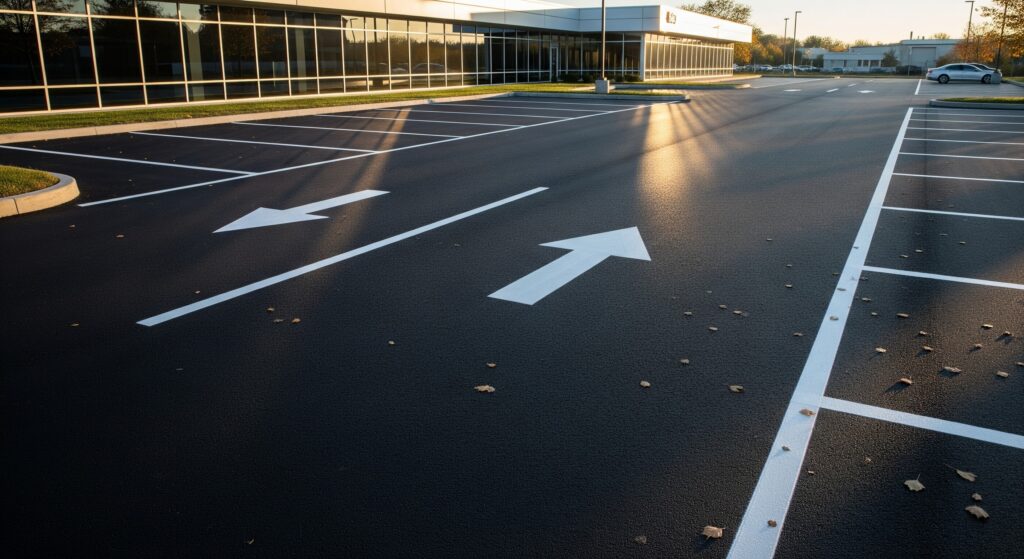
Effective paving also supports safer traffic flow. Clear striping guides drivers. Durable directional arrows keep vehicles moving in predictable patterns. Marked pedestrian aisles protect foot traffic in busy zones.
Drainage is another crucial safety factor. Water accumulation leads to ice formation in cold climates and algae growth in warm climates. Both create hazardous surfaces. Proper paving uses the right elevation, slope, and grading to move water off the surface instead of letting it settle. Pavement that is engineered correctly prevents standing water from creating liability and property damage.
Businesses protect visitors and employees when paving is maintained with care. Safety improvements reduce the risk of accidents and lawsuits, which gives owners peace of mind and a stronger foundation for daily operations.
Why Structural Integrity Matters for Heavy Traffic
Commercial and industrial properties frequently serve heavier vehicles, larger loads, and repeated cycles of equipment movement. Forklifts, delivery trucks, waste management vehicles, and transport carriers introduce stress that residential pavement never experiences. This means the design requirements differ significantly.
Proper paving accounts for the property’s load demands. Engineers assess soil condition, base layer requirements, drainage capacity, and the appropriate thickness of the asphalt or concrete surface. Using the wrong mix or insufficient depth results in premature cracking and deformation. When the subbase is weak or unprepared, the pavement loses stability over time. Once structural damage begins, surface repairs become temporary. Eventually, full reconstruction is required, which is far more expensive.
Businesses that invest in the right paving approach from the beginning experience a longer pavement lifespan and fewer disruptions. Industrial yards, distribution centers, warehouse access lanes, and commercial loading areas function more smoothly when the pavement supports operational weight properly.
How Proper Paving Supports Operational Efficiency
A well-paved commercial or industrial property increases the efficiency of daily activity. Every part of the pavement contributes. Parking areas support predictable organization. Drive lanes direct movement without confusion. Smooth surfaces minimize delays for vehicles that move goods or equipment. Elevation control ensures that water moves away from entrances and work zones instead of flowing into them.
Employees and visitors reach their destinations faster on a property with a clear layout and durable paving. Delivery drivers find loading docks with ease. Service trucks have reliable access. Customers move through the area with confidence rather than caution.
Even small inefficiencies add up over time. Slow movement caused by uneven surfaces or confusing routes affects productivity. Frequent stoppages for temporary repairs disrupt schedules. Proper paving eliminates these bottlenecks and strengthens the rhythm of daily operations.
The Connection Between Quality Paving and Property Value
Property value depends heavily on condition. Paving is one of the most visible and expensive aspects of commercial real estate. Well-maintained pavement improves curb appeal and contributes to premium valuation. Investors and future buyers evaluate the lifespan, repair history, and structural stability of the paving system. Quality pavement signals controlled costs and thoughtful care.
Proper paving also protects other structural investments. Good drainage keeps water from seeping into foundations. Smooth surfaces prevent vibrations that affect nearby structures over time. Clear pathways support landscaping and prevent erosion. Everything around the building benefits when pavement is engineered and maintained correctly.
On the financial side, quality paving reduces long-term repair costs. Businesses that install low-quality surfaces often face repeated patchwork fixes and early failures. Strong pavement lasts longer, requires fewer repairs, and preserves the property’s overall worth.
Regulatory Compliance and Accessibility Requirements
Commercial and industrial properties must meet regulations that govern accessibility, surface conditions, and traffic guidance. Proper paving ensures compliance with these standards. Marked accessible parking spaces, correct signage, adequate space dimensions, and smooth transitions from parking areas to walkways are essential.
Properties also must meet drainage and environmental requirements. Stormwater management affects how pavement is graded and where runoff is directed. In industrial settings, the requirements can be more complex. Improper drainage can impact the surrounding land and cause environmental violations.
Fire lane marking is another important compliance factor. Emergency services rely on clearly defined, unobstructed pathways. Proper paving and striping ensure that emergency access is always available.
Businesses that adhere to compliance standards reduce the risk of penalties and improve accessibility for every visitor.
The Role of Drainage and Soil Stability in Long-Lasting Pavement
Many pavement problems begin beneath the surface. Soil stability influences how pavement settles over time. If the soil is improperly compacted or holds excess moisture, the pavement will shift, crack, or sink. Commercial and industrial properties require a strong base layer because of heavier usage and larger paved areas.
Drainage is equally important. Water is one of the most damaging elements to pavement. Without proper slope and flow, moisture seeps into cracks, freezes in colder weather, and weakens the pavement from the inside. Even in warmer regions, water penetration leads to erosion and undermining of the subbase.
Proper paving includes attention to elevation, compaction, and subbase thickness. These factors create a stable foundation that extends pavement life and supports everyday demands. When contractors ignore these elements, visible defects appear sooner, and repairs become more frequent.
Material Quality and Why It Matters
Different paving materials perform differently under heavy use. Asphalt and concrete remain the two most common options for commercial and industrial properties. Each offers unique advantages depending on how the property functions.
High-quality asphalt provides flexibility and durability, making it suitable for parking areas and access roads with heavy vehicle traffic. Proper installation requires precision with temperature, compaction, curing time, and aggregate selection.
Concrete is preferred for industrial yards, loading docks, and areas with stationary heavy loads because of its compressive strength. It must be mixed, poured, and finished with strict controls to prevent cracking and surface defects.
Using the correct material is essential, but using the correct quality level is equally important. Low-grade materials may appear acceptable at first, but break down quickly under the pressure of commercial operations. Selecting the right mix ensures the pavement stands up to environmental and mechanical stress.
Maintenance Practices That Protect Pavement Longevity
Even the strongest pavement benefits from proper maintenance. Sealcoating protects asphalt from UV exposure and moisture. Crack sealing prevents water infiltration. Regular cleaning removes debris that can trap moisture or cause deterioration. Striping refreshes visibility, which maintains safety.
Industrial properties require additional attention due to equipment intensity. Heavy turning movements create surface stress. Chemical exposure from industrial materials can degrade the pavement. Frequent inspections help identify early signs of wear before they become expensive issues.
Maintenance extends pavement lifespan significantly. Businesses that schedule regular assessments and take preventive actions enjoy lower lifecycle costs and fewer disruptions.
How Proper Paving Supports Sustainability
Sustainability plays a growing role in property management. Thoughtful paving can align with environmental goals. Drainage systems move stormwater responsibly. Permeable pavement options reduce runoff volume. Durable surfaces require fewer materials over time, which lowers consumption and waste. When pavement lasts longer, fewer resources are needed for reconstruction.
Sustainable design also protects the surrounding environment. Proper grading prevents erosion. Stormwater management reduces pollution. Businesses that prioritize sustainable paving support their environmental objectives while maintaining high performance.
Supporting Heavy Machinery and Specialized Equipment
Industrial properties rely on specialized vehicles and equipment. Forklifts, cranes, transport units, loaders, and other high-pressure machinery require pavement capable of supporting concentrated weight. This requires a stronger subbase, reinforced materials, and precise engineering.
Improper paving limits where machinery can operate. When pavement begins to rut or crack, equipment movement becomes restricted. Repairs disrupt operations and create schedule delays. Strong pavement supports full access without risk of damage or instability.
Proper paving also supports the storage of heavy materials. Industrial yards often store supplies that place significant stress on surface areas. Paving that is engineered for these loads remains stable even under continuous pressure.
Traffic Flow and Visitor Experience
Smooth traffic flow is essential in commercial areas where customers, delivery vehicles, and employees arrive simultaneously. Clear layout supports easy navigation. Efficient entry and exit points reduce congestion. Marked pedestrian walkways protect foot traffic.
When pavement is poorly designed or has deteriorated, traffic slows down. Confusion increases. Parking becomes stressful. Delivery drivers struggle to locate designated areas. A well-paved property improves movement and creates a calmer, safer, and more inviting atmosphere.
Industrial properties benefit as well. Traffic flow affects logistics. When vehicles move smoothly, turnaround times improve. Clear striping and durable surfaces help drivers position properly during loading and unloading. Pavement structure influences the entire logistics chain.
The Hidden Costs of Low Quality Paving
Low-quality paving often appears cost-effective at the beginning, but hidden expenses emerge as the pavement ages prematurely. Frequent patching, emergency repairs, and early resurfacing lead to higher long-term costs. Business operations are interrupted more often, which may affect customer service or production schedules.
Poor paving also increases liability. Accidents related to unstable surfaces or poor drainage can result in costly claims. Equipment repairs become more frequent when vehicles repeatedly travel over uneven surfaces.
Investing in proper paving reduces these hidden costs. The upfront investment supports smoother operations, protects safety, and reduces the likelihood of expensive future repairs.
The Value of Partnering with a Skilled Paving Company
Commercial and industrial paving requires insight, engineering knowledge, and precision. A skilled contractor evaluates the property thoroughly, identifies long-term needs, and recommends the appropriate materials and design approach. Drainage, soil conditions, load requirements, traffic patterns, and environmental factors influence the paving plan. Experienced contractors understand how these elements work together.
A trusted paving partner guides property owners through maintenance planning, repairs, resurfacing schedules, and long-term strategies. This partnership protects the property’s investment and ensures the pavement supports the business effectively year after year.
Strengthen your property with durable, professional paving from WB Paving. Our team delivers reliable surfaces that enhance safety, performance, and long-term value for commercial and industrial properties. Contact us to schedule an assessment and plan your pavement improvements with confidence.